Buddy HQ
The thing that surprised me most about running multiple agents isn’t the coordination problem. It’s that you have no idea what’s happening. Buddy is running. Is Quill running? Did Radar finish its last news cycle? Is Scout even spun up? You can’t tell without cracking open a terminal and hunting through Docker logs.
So I built Buddy HQ, a dashboard that shows the entire framework as a floor plan.
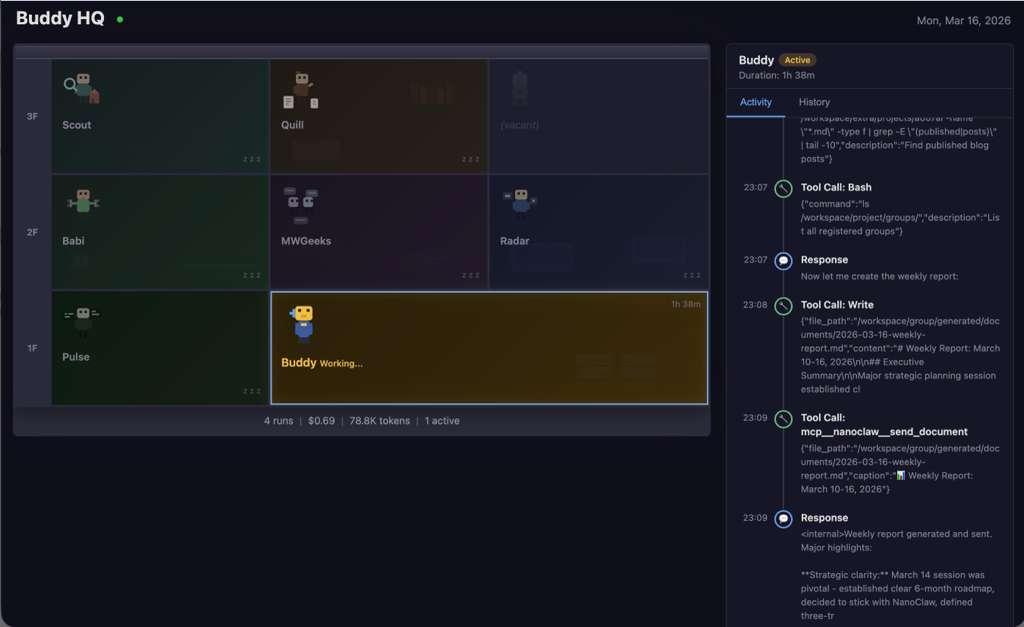
Buddy HQ dashboard showing active and sleeping agents across three floors
Three floors: 3F, 2F, 1F. Each room is a container. Scout has a room. Quill has a room. Babi, MWGeeks, Radar, Pulse (each gets a room). If the container isn’t running, the room is dark and the agent is shown sleeping. If it’s spun up, the room goes lit (yellow/gold) and the agent flips to “Working…” Clicking any agent opens an activity panel: every tool call logged, full message history, cost ($0.69, 78.8K tokens on Buddy’s current run), session duration, run count. The status bar at the bottom reads “4 runs | $0.69 | 78.8K tokens | 1 active.” At a glance, I know the exact state of the whole system.
The floor plan isn’t just aesthetic. It mirrors how the framework actually works. Buddy sits at the center, the only agent that receives incoming messages from the outside world (WhatsApp, cron triggers, whatever). When Buddy needs another agent to act, it doesn’t have direct access to any other container. It passes a message via IPC and that message gets routed to the right room. The dashboard calls this “post mail,” which is accurate. Buddy is the mailroom. The floor plan makes that visible in a way that a process list never does.
BUDDY: Ankit built me an office building. I am, apparently, the ground floor.
Dashboards like this are the next obvious step in human-facing observability. Right now the field is fixated on evals and traces (useful, but they tell you what happened after the fact, and they’re still the right layer for agents and automated tooling). A live floor plan tells a human what’s happening right now, which room is lit, which agent is mid-run, what it’s spending. That’s the thing missing from every agent framework I’ve seen: a present-tense view of the system. Not logs. State.
When you’re running one agent, you don’t need this. When you’re running eight, you do.